
Caregiver Burnout Is Real: How to Recognize It, Name It, and Find Your Way Through It
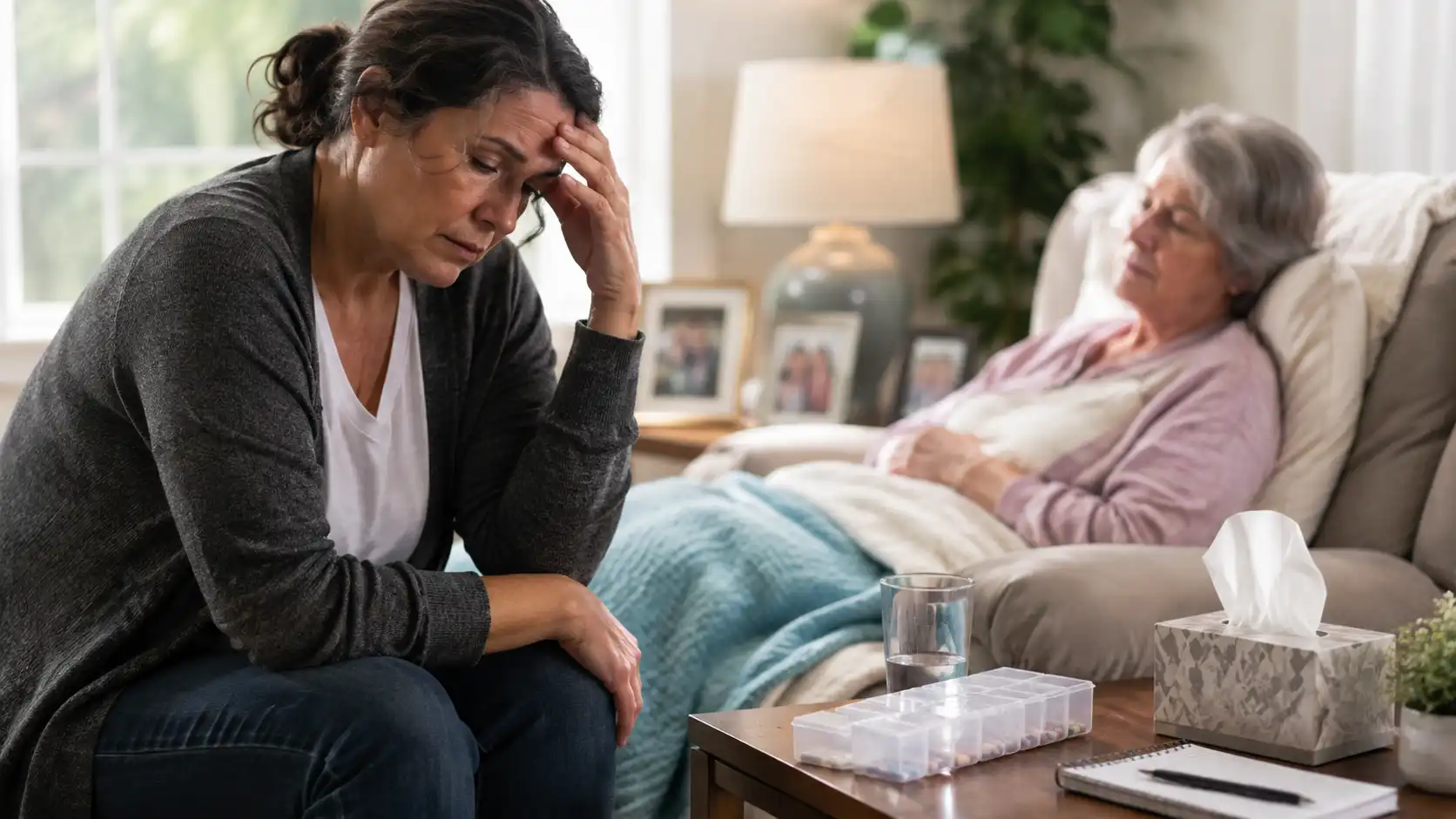
For a long time after my Nonna Lidia died, I thought I was fine.
I went back to work. I kept my calendar full. I answered emails. I smiled in meetings. I projected exactly the kind of strength that my Nonna would have expected from me, that my mother had always modeled for me, that my grandfather's strict standards had trained into me from the time I was a little girl in our home in Italy. In our family, you showed up. You did not fold.
But privately, things were different. I was crying when no one could see me. I could not sleep. I stopped eating the way I should, and more than once my mother had to come to my house to make sure I had eaten at all. There were days I felt I would never really be myself again.
What I did not understand then, and what took me years of reflection to fully recognize, is that what I was experiencing had started long before my Nonna died. It started during the caregiving itself. In the years of doctor appointments and pharmacy runs and emergency room visits. In the years of watching her dementia take her slowly, that particular grief that happens before the person is actually gone. In the years of making decisions for someone I loved more than I had words for, and then second-guessing every single one of them.
By the time she passed, I was already empty in ways that sleep and routine could not fix. And I was performing a version of myself that looked fine, because I had no idea that what I was actually experiencing had a name.
It does. It is caregiver burnout. And naming it honestly is where the healing begins.
The direct answer: Caregiver burnout is a state of physical, emotional, and mental exhaustion that occurs when the demands of sustained caregiving exceed a person's capacity to cope. It is distinct from normal caregiver stress in that it is chronic, does not resolve with ordinary rest, and often builds invisibly over months or years behind a front of competence and strength. Signs include persistent fatigue, emotional detachment from the person being cared for, resentment followed by guilt about the resentment, withdrawal from relationships and activities that once brought joy, and neglect of one's own health. It is not a character failure. It is a human response to an extraordinary demand.
The Difference Between Caregiving Stress and Burnout
Not every hard week of caregiving is burnout. Caregiving is genuinely hard. There will be difficult days, difficult phone calls, difficult moments in hospitals and nursing homes and care facilities. That difficulty, even when it is significant, is different from burnout.
Caregiver stress comes and goes. It responds to a good night of sleep, to a conversation with someone who understands, to a day when things go relatively well. It is episodic.
Burnout is cumulative. It builds over time, quietly, beneath the surface of everything you are managing. It does not respond to rest because it runs deeper than physical fatigue. You can sleep eight hours and wake up feeling exactly as depleted as when you closed your eyes.
The other thing that distinguishes burnout is what it does to your relationship with the person you are caring for. This is the symptom that caregivers are most reluctant to admit, because it feels like a betrayal: a kind of numbness, or emotional distance, from the person you love. You can still go through every motion of care. You can still be present in every practical sense. But the love that used to make those motions feel meaningful becomes harder to access. You are running on something else. Duty, maybe. Habit. The way you were raised.
This is not a character failure. This is a symptom. And it is far more common than any caregiver will tell you, because we do not talk about it.
What Burnout Looked Like For Me
I was the Chief Operating Officer of an elder law firm. I was a professional who helped other caregiving families navigate these exact situations every day. I understood the system from the inside.
And I still missed it completely when it was happening to me.
Looking back at the years of caring for my Nonna alongside managing our growing practice, being a wife and a mother to my boys Dante and Gino, keeping all the plates spinning that everyone around me depended on me to keep spinning, I can see what I could not see then. I was not functioning. I was performing functioning. And there is a very significant difference.
There were moments that showed me who I actually was underneath the performance. I remember the day I barged into an emergency room because the EMTs had transported my Nonna to the hospital against my explicit instructions. I was her Power of Attorney. I had told them not to bring her. She was frightened, and she was Italian, and hospitals made everything worse for her. When I arrived and found she was already there, I came apart. I shouted at those EMTs in a way that, when I replayed it later, made me deeply ashamed. I was not that person. But burnout had been stripping away the edges of who I was, and that moment was one of the places where it showed.
There was also the Medicaid paperwork. I had relied on the rehabilitation facility to follow up on a piece of documentation that would have saved thousands of dollars in Nonna's care costs. I forgot to follow up myself. And this from the COO of an elder law firm, someone who taught her own team that follow-up was non-negotiable. The bill went unpaid. The account went to collections. And I sat with that guilt for years, adding it to the pile of things I had done wrong.
I want to tell you about these things not because they are flattering, but because they are true. And because when I finally stood in front of a room of accomplished women at a peer mentoring group I belonged to and broke down crying in a business setting, which was absolutely the last thing my grandfather's strict sensibilities would have approved of, those women understood. They had their own versions of the same pile. They were not shocked. They were present.
That moment was the beginning of me understanding that I had not been okay for a long time.
What Burnout Actually Looks Like
For those who have not named it yet, here are the signs that the pile has gotten too heavy.
Physical signs: Fatigue that sleep does not fix. Getting sick more often. Appetite changes. Headaches, muscle tension, or other physical symptoms that do not have a clear medical cause. Your body is telling you something that your schedule will not let you hear.
Emotional signs: Numbness or detachment toward the person you are caring for. Feelings of hopelessness or being trapped. Increased irritability in situations that have nothing to do with caregiving. Crying without knowing why, or the opposite: being unable to cry even when you feel like you should. This is sometimes the thing that frightens people most. Not the sadness, but the flatness.
The resentment. It comes for almost every sustained caregiver at some point. Resentment toward siblings who are not doing their share. Resentment toward the care system for being inadequate. Sometimes, if we are being fully honest, resentment toward the person we are caring for, not because we do not love them, but because the situation is so hard and there is no one else to aim the feeling at. And then immediately after the resentment, the guilt. The internal interrogation: How can I feel this? What kind of person am I?
I will tell you what kind. The human kind. The one who loves deeply enough that this is costing you something.
Behavioral signs: Pulling away from people and activities you used to value. Neglecting your own medical care, your own mental health, your own needs, because every available unit of attention goes somewhere else.
Secondary grief. For those of us who cared for someone with dementia, there is a specific dimension of burnout that deserves its own name. It is grief that runs alongside the caregiving itself. You are losing the person before they are gone. The Nonna I knew, who said yes when my mother said no, who walked me to school every morning, who coddled me and loved me with a completeness that I have never stopped being grateful for, was not fully that woman in the last years of her life. I was grieving her while she was still here. That grief is real, and it is heavy, and it belongs on this list.
Why Caregivers Do Not Ask For Help
The reasons are many, and most of them make a kind of sense when you are inside the experience.
In Italian families, and in many immigrant and multigenerational cultures, there is an expectation that family takes care of family. Not as a preference. As an identity. Asking for help from outside can feel like admitting failure, like saying your family is not enough. I lived inside that expectation. I understood it from the inside. It did not make it less heavy.
There is also the very practical fear that if you step back, even briefly, the care infrastructure collapses. And often that fear is at least partially accurate. You are the one who knows her medications, her routines, her fears. You are the one she trusts. Who else is going to do this?
That question, asked often enough, becomes a trap. Because the answer to "who else" can only be found if you make enough space to look for it.
What Actually Helps
Respite care. This is care provided by someone other than you, specifically to give you a genuine rest. In New Jersey, respite resources are available through certain Medicaid programs, the NJ Division of Disability Services, Area Agencies on Aging, and organizations including Alzheimer's New Jersey. It is not abandoning your loved one. It is what makes continuing to show up for them possible.
Support groups. There is a specific kind of relief that comes from being in a room with people who are living exactly what you are living. It is different from the support of friends and family, however loving. People who have not been a caregiver cannot fully understand it. People who are in the middle of it absolutely can.
Therapy and mental health support. I am not going to soften this. Caregivers are at significantly elevated risk for depression, anxiety, and complicated grief. These are conditions that respond to treatment. There is no virtue in managing clinical depression with willpower alone. Please consider it.
Personal Care Agreements. If you are a family member who is providing substantial care for a parent, a legal tool called a Personal Care Agreement may allow you to be formally compensated for that work. It must be structured correctly to avoid creating Medicaid complications, but it is a real option that most caregivers do not know exists. Your labor has value. The law can reflect that.
The legal planning piece. One of caregiving's most exhausting hidden burdens is legal uncertainty. Not having the formal authority to manage a parent's finances or make medical decisions creates friction in every interaction with every institution. A current, comprehensive Durable Power of Attorney, a Healthcare Proxy, an estate plan, a Medicaid plan that is underway: these documents do not just protect your loved one. They protect you. They replace daily uncertainty with daily clarity. And that is one of the few forms of genuine relief that is actually within reach.
What I Learned, Finally
I became a Certified Dementia Practitioner not because it was a credential I was required to have, but because after everything I experienced caring for my Nonna, I needed to understand what had happened. I needed to be able to give other families the guidance I had not had.
And I help run an elder law firm because I know, firsthand, that the families who fare best are the ones who had someone walking alongside them. Not just drafting documents. Walking alongside.
If you are reading this in the middle of your caregiving season, I want you to hear me clearly. You are not failing the person you love by being exhausted. You are not weak for struggling. You are carrying something that most people cannot imagine, and you are doing it because you love someone. That love counts. Even on the days it does not feel like enough.
Take care of yourself. Not just so you can take better care of them, though that is true. Because you matter in this story too.
Frequently Asked Questions
Q: What is caregiver burnout? Caregiver burnout is a state of physical, emotional, and mental exhaustion that builds from sustained caregiving without adequate support. It is distinguished from normal caregiver stress by its chronic, progressive nature and by symptoms including persistent fatigue that rest does not fix, emotional detachment from the person being cared for, resentment followed by guilt, withdrawal from relationships and activities, and neglect of personal health. It is a recognized, real condition, and it is not a personal failure.
Q: How do I know if I have caregiver burnout? Key signs include fatigue that does not improve with sleep, emotional numbness or detachment toward the person you are caring for, resentment followed by guilt about the resentment, withdrawal from friends and activities you used to enjoy, neglect of your own medical care, increased irritability in situations unrelated to caregiving, and difficulty concentrating. If several of these describe your experience, burnout may be present. Talking to a physician or therapist is a good first step toward naming and addressing it.
Q: What is respite care in NJ? Respite care is temporary care provided by someone other than the primary caregiver, specifically to give the primary caregiver a rest. In New Jersey, respite resources are available through certain Medicaid programs, the NJ Division of Disability Services, Area Agency on Aging programs, and organizations including Alzheimer's New Jersey. Types of respite include in-home aide services, adult day programs, and short-term residential stays. Asking for respite is not abandoning your loved one. It is what allows you to continue showing up for them.
Q: Can I be paid for caring for my parent in NJ? Yes, through a properly structured Personal Care Agreement. A family caregiver can be legally compensated for care services provided to a parent or other family member. The agreement must be in writing, signed before services begin, establish a reasonable market rate for the services, and document services performed. Payments under a valid Personal Care Agreement are not treated as penalized transfers for Medicaid purposes. Contact an elder law attorney to establish a valid agreement.
Q: What legal documents help reduce caregiver stress? A current, comprehensive Durable Power of Attorney removes daily friction with financial institutions and government agencies. A Healthcare Proxy clarifies medical decision-making authority. A Medicaid plan in progress removes the financial terror of the future. An updated estate plan removes anticipatory family conflict. Together, these documents transform legal uncertainty into legal clarity, which is one of the few concrete forms of caregiver relief that is genuinely within reach.
If you are holding everything together right now, you deserve support too. Our team is here for the legal work, and for the conversation behind it. Schedule a Consultation.
Attorney Advertising. Prior results do not guarantee a similar outcome.
Recent posts
Explore more and stay updated on important legal topics affecting you and your loved ones.
Supported Decision-Making in New Jersey: A Rights-Preserving Alternative to Guardianship

What Happens to Your Business When You Can't Run It? Estate Planning for New Jersey Business Owners

What Is a Medicaid Compliant Annuity, And How Does It Protect Your Family's Assets in New Jersey?
Get the Support You Deserve
Whether you’re planning ahead or facing an urgent legal matter, our team is here to help. Schedule a consultation or contact us today to get started.
