
Supported Decision-Making in New Jersey: A Rights-Preserving Alternative to Guardianship

When a family member has a disability, one of the most important and least-discussed questions a family faces is this: who has the legal authority to help them?
Most families assume the answer is guardianship. They have heard the word. They know it means someone is legally appointed to make decisions for another person. What they often don't know is that guardianship is not the only option, and for many families, it is not the right one.
In New Jersey, there is a spectrum of legal arrangements for supporting someone with a disability in making decisions. At one end is a Durable Power of Attorney, which the individual signs themselves. In the middle is Supported Decision-Making, which keeps all legal rights with the individual while surrounding them with structured support. At the other end is guardianship, which transfers legal authority to another person through a court proceeding.
No single option is right for every family. The goal of this article is to explain all three clearly, so your family can make an informed choice that fits your specific situation.
The direct answer: Supported Decision-Making (SDM) is an arrangement in which a person with a disability keeps all of their legal rights, and a network of trusted people helps them understand information, think through options, and communicate their choices. It differs from a Power of Attorney, where the individual signs over specific authority to another person, and from guardianship, where a court removes legal rights and transfers them to a guardian. SDM is not the right fit for every situation, but for many individuals, it allows them to make their own decisions with meaningful support rather than having decisions made for them.
Start Here: What Does "Legal Authority" Actually Mean?
Before explaining the three options, it helps to understand what is actually at stake.
When someone has a disability, the people who love and support them often begin making decisions on their behalf informally. They accompany them to doctor's appointments and speak up. They help manage bills. They talk with teachers, employers, or benefit agencies on their behalf.
This informal support works until it doesn't. A hospital may refuse to share medical information with a family member who has no legal authority to receive it. A bank may not allow someone to manage an account they have no legal access to. A government agency may communicate only with the person receiving benefits, even when that person struggles to understand or respond to what is being asked.
When informal support runs into a formal wall, legal authority becomes necessary. The question is: what kind, and how much?
Option 1: The Durable Power of Attorney
A Durable Power of Attorney (DPOA) is a legal document that a person signs voluntarily, giving another person, called the agent, authority to act on their behalf in specific areas.
The key word is "voluntarily." A DPOA can only be created by someone who has legal capacity, which means the ability to understand what they are signing and what authority they are granting. The document is drafted by an attorney, signed by the individual, and notarized.
What makes a DPOA different from the other options:
The individual remains in full control of their own legal rights. They simply choose to allow a trusted person to help them manage certain things. The DPOA can be as broad or as narrow as the individual chooses. It can be revoked if the individual changes their mind, as long as they still have capacity. It does not require court involvement and can be put in place quickly.
A Healthcare Proxy, which is a companion document, allows someone to make medical decisions on the individual's behalf if they cannot make those decisions themselves at that moment.
When a DPOA is the right fit:
A DPOA works well when the individual understands what they are agreeing to and is comfortable designating someone they trust to act on their behalf in specific areas. It is the least restrictive formal legal arrangement available, and it respects autonomy while providing practical legal authority where it is needed.
When a DPOA may not be enough:
If the individual does not have sufficient capacity to sign the document, a DPOA is not available to them. It cannot be created after capacity has been lost. And because it can be revoked, it may not offer enough protection in situations where the individual is vulnerable to manipulation.
Option 2: Supported Decision-Making
Supported Decision-Making is built on a straightforward idea: most people, regardless of disability, can make meaningful decisions about their own lives when they have the right support. What they may need is help understanding information, considering options, and communicating their choices.
SDM does not transfer any legal rights. The individual with a disability remains the legal decision-maker. The supporters, who may be family members, friends, teachers, or others the person trusts, simply help them navigate decisions more effectively.
What this looks like in practice:
A young man with an intellectual disability wants to make his own decisions about where he works and where he lives. He has trouble reading complex documents and sometimes needs information explained in simpler terms. With an SDM arrangement, he has two supporters who attend meetings with him, help him understand his options, and make sure his voice is the one driving the outcome. He signs his own documents. He communicates his own choices. His supporters are there to help, not to speak for him.
The Supported Decision-Making Agreement:
SDM is typically formalized in a written document, called a Supported Decision-Making Agreement, that identifies who the supporters are, which areas of life they assist with, and how that support works in practice. This document is not a court order. It does not grant supporters legal authority. But it provides a clear, written record of the arrangement that many hospitals, government agencies, and service providers will recognize.
How SDM differs from a Power of Attorney:
In a DPOA, the agent has legal authority to act on the individual's behalf, with or without the individual's involvement in the specific decision. In SDM, the individual always remains the decision-maker. Supporters help but never substitute their judgment for the person's own. If someone signs a document, it is the individual signing it, not the supporter.
How SDM differs from guardianship:
In guardianship, a court removes legal rights from the individual and grants them to a guardian. The guardian makes decisions. The individual's own preferences may be considered, but they are not legally in control. In SDM, no legal rights are removed. The individual is always in control, with support available when they need it.
When SDM is the right fit:
SDM works well for individuals who can make authentic decisions about their own lives, particularly when they have a trusted network of people willing to provide support. It is often appropriate for people with mild to moderate intellectual disabilities, many autistic individuals, people with certain mental health conditions, and those with cognitive challenges that affect some areas of functioning but not others.
When SDM may not be enough:
SDM is not a formal legal authority. There are situations where an individual needs a legally recognized representative, whether because their cognitive limitations are more significant, because institutions require formal documentation, or because there is a risk of exploitation that informal support arrangements cannot adequately address. In those situations, more formal legal authority may be necessary.
Option 3: Guardianship
Guardianship is a legal process in which a court determines that an individual lacks the capacity to make certain decisions, and appoints a guardian to make those decisions on their behalf.
It is the most significant legal intervention available. When a court grants guardianship, the individual loses legal rights, sometimes across a broad range of decisions including where they live, what medical treatment they receive, and how their money is managed.
Full (plenary) guardianship gives the guardian authority across most or all decision-making areas.
Limited guardianship restricts the guardian's authority to specific domains where the individual has been found to lack capacity, preserving their legal rights in other areas. New Jersey courts are required to consider the least restrictive option that meets the individual's needs.
The guardianship process in NJ:
Guardianship requires filing a petition in the Superior Court, a medical evaluation documenting the nature of the individual's incapacity, a court-appointed attorney to represent the individual's interests, and a hearing before a judge. The process typically takes three to five months and costs between $5,000 and $10,000 in legal and evaluation fees.
When guardianship is the right fit:
Guardianship is appropriate when an individual's cognitive limitations are significant enough that decision-making support is not sufficient to protect their wellbeing, when there is a serious risk of exploitation or harm that requires a legally recognized authority to prevent, or when institutions and agencies require formal legal authority that a DPOA or SDM agreement cannot provide.
The Comparison Every Family Needs to See
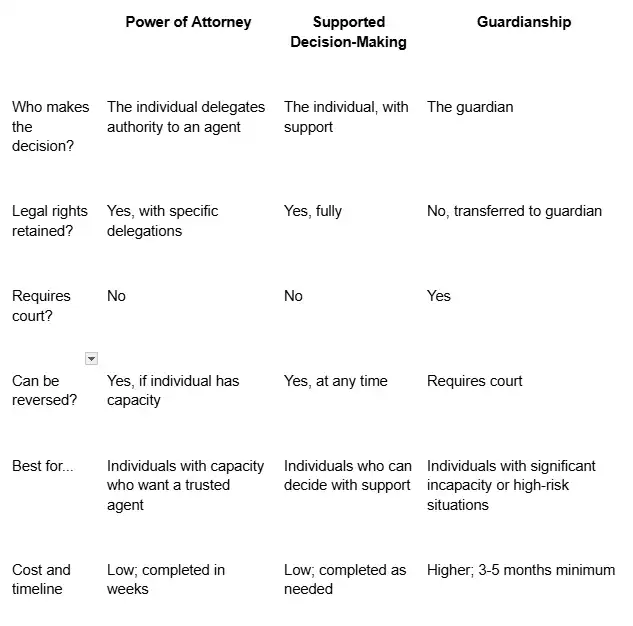
Every Family Is Different
There is no formula that tells you which of these options is right for your family member. The right answer depends on who they are, what they can do, what kind of support they have around them, and what the specific decisions or situations require.
Many families use a combination of approaches. A young adult with an autism spectrum condition might sign a Healthcare Proxy and a DPOA for financial matters, while using a Supported Decision-Making Agreement for daily life decisions. An individual with a more significant intellectual disability might benefit from limited guardianship in the areas where they need the most protection, while using SDM for the many areas of their life where they can participate meaningfully.
What we encourage every family to avoid is assuming that guardianship is the default, or the only option. The disability rights movement in New Jersey and nationally has worked hard to ensure that the law recognizes individuals with disabilities as having rights worth preserving, and that legal frameworks reflect the reality that most people can participate in their own lives when given the right support.
At NJ Elder Law Center, Valerie Buccino brings nearly 30 years of experience and admission to both the New York and New Jersey bars to these conversations. We do not begin any family consultation with a predetermined answer. We begin by listening, because the right answer is always specific to the person at the center of the discussion.
Frequently Asked Questions
Q: What is supported decision-making in New Jersey? Supported decision-making is an arrangement in which a person with a disability keeps all of their legal rights and makes their own decisions, with help from trusted supporters who assist them in understanding information, thinking through options, and communicating their choices. Supporters do not make decisions for the person. A Supported Decision-Making Agreement is a written document that formalizes these relationships and identifies which supporters assist with which areas of life.
Q: How is supported decision-making different from a Power of Attorney? In a Durable Power of Attorney, the individual grants an agent the legal authority to act on their behalf in specific areas, meaning the agent can take action without the individual's direct involvement in every decision. In supported decision-making, the individual always makes their own decisions. Supporters help but do not hold any legal authority to act independently. The individual retains complete legal control.
Q: How is supported decision-making different from guardianship? Guardianship involves a court removing legal rights from an individual and granting them to a guardian, who then makes decisions on the individual's behalf. In supported decision-making, no legal rights are removed. The individual remains the legal decision-maker. Supported decision-making is a rights-preserving alternative for individuals who can make authentic decisions with appropriate support.
Q: Is supported decision-making legally recognized in New Jersey? New Jersey does not yet have a specific statute formally establishing supported decision-making agreements, but they are increasingly recognized by courts, the Division of Developmental Disabilities, healthcare providers, and other agencies as evidence of a functioning support system. The legal standing of SDM in NJ continues to grow as law and practice evolve in this direction.
Q: When does my family member need guardianship instead of supported decision-making? Guardianship may be more appropriate when an individual's cognitive limitations are significant enough that decision-making support alone cannot protect their wellbeing, when there is a serious exploitation risk that requires legally recognized authority to prevent, or when institutions require formal legal documentation that an SDM agreement cannot provide. Many families find that a combination of approaches, such as limited guardianship in certain areas and SDM in others, is the best fit.
Q: Who can be a supporter in a supported decision-making arrangement? Supporters can be any trusted person who knows the individual well and is committed to helping them make their own decisions rather than directing those decisions. Common supporters include family members, close friends, teachers, job coaches, faith community members, or service providers. The individual chooses their own supporters. Different people may assist with different areas, such as one person for healthcare and another for financial matters.
Every individual with a disability deserves a planning approach that honors who they are. Our team takes the time to understand your family member's specific abilities and situation before recommending any legal arrangement. Schedule a Consultation.
Attorney Advertising. Prior results do not guarantee a similar outcome.
Recent posts
Explore more and stay updated on important legal topics affecting you and your loved ones.

Caregiver Burnout Is Real: How to Recognize It, Name It, and Find Your Way Through It

What Happens to Your Business When You Can't Run It? Estate Planning for New Jersey Business Owners

What Is a Medicaid Compliant Annuity, And How Does It Protect Your Family's Assets in New Jersey?
Get the Support You Deserve
Whether you’re planning ahead or facing an urgent legal matter, our team is here to help. Schedule a consultation or contact us today to get started.
