
The New Jersey Medicaid Application: What to Expect, What You'll Need, and How to Avoid the Mistakes That Cause Delays

The Medicaid application is where planning meets paperwork. All the strategic thinking, the irrevocable trust creation, the asset protection work, it culminates in an application that must be prepared correctly, submitted with complete documentation, and managed through an agency review process that is unforgiving of errors.
Most families significantly underestimate what this process involves. They assume that because they have done the planning, or because the need is urgent, the application is a formality. It is not. An incomplete or improperly prepared Medicaid application in New Jersey can create delays of months, during which the nursing home is billing at $12,000 to $14,000 per month and the family is paying out of pocket.
The most common call we receive from families who tried to navigate the Medicaid application without legal help: "We submitted everything weeks ago and we haven't heard anything. The nursing home is threatening to discharge my mother. What do we do?"
The answer, at that point, involves emergency remediation of a situation that would have been straightforward if handled correctly from the beginning. This post is designed to prevent that call.
The direct answer: New Jersey Medicaid for long-term nursing home care is administered by county Boards of Social Services under the oversight of the NJ Division of Medical Assistance and Health Services (DMAHS). The application requires five years of complete financial documentation (the look-back review), medical documentation establishing nursing facility level of care, and correct completion of state-specific forms. The most common causes of delay are incomplete financial documentation, missing or incomplete Pre-Admission Screening (PAS), and unexplained financial transactions. Working with an elder law attorney from the point of admission, not weeks or months after, produces the best outcomes.
Who Administers the NJ Medicaid Application
NJ Medicaid for long-term nursing home care (technically called NJ FamilyCare ABD: Aged, Blind, and Disabled) is administered locally through the County Board of Social Services in the county where the applicant resides.
Key county offices serving the communities where NJELC clients are concentrated:
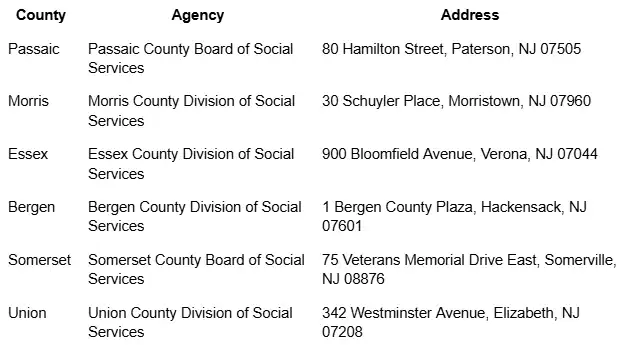
Our team manages all communications with these agencies on behalf of our clients. This includes submitting applications, responding to requests for additional information, tracking case status, and escalating when necessary.
Start the Process on Day One of Admission
The single most important thing to understand about the NJ Medicaid application timeline is this: the application can and should be filed as soon as possible after nursing home admission, even before the applicant is financially eligible.
There is no penalty for filing early. There is a significant cost for filing late.
Filing early establishes the application date, which matters because Medicaid coverage is retroactive to the first day of the month in which the application is filed, if eligibility is eventually established. A family that waits three months to file loses three months of potential Medicaid coverage, paying privately for care that Medicaid could have covered.
On the day of admission, or as close to it as possible:
- Contact our office to begin the application management process
- Begin gathering financial documents (see below)
- Confirm that the Pre-Admission Screening (PAS) has been ordered or is underway
- Notify the nursing home that a Medicaid application is being prepared
The Complete Document Checklist, What You'll Need
This is the most critical section of this post. The single most common cause of NJ Medicaid application delay is incomplete financial documentation. The county worker cannot process an application without a complete financial picture.
Financial Documents: Five Years of History
NJ Medicaid reviews financial transactions from the 60 months (5 years) before the application date. Every financial account that existed during any portion of that 5-year period must be documented.
Bank statements: 60 months of complete, consecutive monthly statements for every bank account, checking, savings, money market, CDs, that the applicant owned or co-owned during the look-back period. This includes accounts that were closed during the look-back period. If statements are missing (especially from accounts closed years ago), contact the bank to obtain historical records as far back as possible.
Investment account statements: 60 months of statements for any brokerage, mutual fund, or investment account.
Retirement account statements: 60 months of IRA, 401(k), 403(b), or pension statements.
Life insurance policies: Copy of every life insurance policy owned by the applicant, with the current cash value documented.
Real estate documentation: Deed for any real estate owned by the applicant. Tax assessment records. Mortgage statements if applicable.
Vehicle title: Title document for any vehicle.
Trust documents: Copy of any trust document in which the applicant is named as grantor, trustee, or beneficiary.
Records of significant financial transactions: Any transaction exceeding a modest threshold, typically $1,500 to $2,000, that occurred within the look-back period should be accompanied by documentation explaining the nature of the transaction. This includes: checks written to family members, cash withdrawals, charitable donations, transfers between accounts, and any purchase or sale of real estate or other significant assets.
Personal and Identification Documents
- Birth certificate
- Social Security card and/or a letter showing the Social Security number
- Medicare card
- Proof of citizenship or lawful immigration status
- Marriage certificate (if married)
- Death certificate of spouse (if widowed)
- Divorce decree (if divorced)
Medical Documentation
The Pre-Admission Screening (PAS) is a clinical assessment conducted by a state-authorized nurse that determines whether the applicant meets the Nursing Facility Level of Care standard: the medical criteria for Medicaid nursing home coverage. This is a separate, required step that many families don't know about and that causes significant delays if not completed in a timely manner.
The PAS must be completed before Medicaid coverage can begin. It is typically ordered by the nursing home or the county social services office. If the PAS has not been scheduled at the time of admission, ask the nursing home's social worker to initiate it immediately.
Hospital records supporting the nursing home admission, recent physician's records documenting the medical need for nursing facility level of care, and any specialist records relevant to the primary diagnosis should also be gathered.
Income Documentation
- Social Security award letter (current year)
- Pension award letter and current pension statement
- Any rental income documentation
- Any other income documentation
The Look-Back Review, How the County Examines 5 Years of Financial History
Once the application is submitted with complete documentation, the county's Medicaid caseworker reviews the financial records to identify any transfers made for less than fair market value within the 60-month look-back period.
The caseworker is looking for:
- Gifts to family members (including regular cash gifts, checks, or transfers)
- Below-market transfers of real estate
- Transfers to or from joint accounts
- Large cash withdrawals that cannot be explained
- Funding of irrevocable trusts (within the look-back period)
- Charitable donations exceeding nominal amounts
Every significant transaction that might look like a disqualifying transfer needs an explanation and supporting documentation. A $10,000 transfer to a child three years ago requires documentation of its nature: was it a gift? A loan? Payment for caregiving services under a Personal Care Agreement? Repayment of a debt? Each of these has different Medicaid implications, and the documentation must support the explanation.
When our team prepares a NJ Medicaid application, we review the full 5-year financial history before submitting and prepare a written explanation for every transaction that may draw scrutiny. This proactive approach prevents the caseworker from issuing a deficiency notice, a request for additional information that extends the review timeline by weeks or months.
The Most Common Mistakes That Cause Delays
These are the errors we most frequently remediate when families come to us after having filed on their own:
Incomplete bank statements. A single missing month in a 60-month bank statement history causes the entire application to be placed on hold until the complete record is obtained. Banks can take weeks to provide historical records.
No PAS in place at the time of application. Applications submitted without a completed Pre-Admission Screening cannot be processed. If the PAS is pending, note this in the application and follow up with the county to coordinate timing.
Unexplained transactions. Any transfer above the county's scrutiny threshold that lacks an explanation and supporting documentation will generate a deficiency notice. These notices stop the clock on the application until resolved.
Errors in the income calculation. Particularly for married couples, the income calculation is complex, involving both the applicant's income and the community spouse's income, with different rules for each. Errors here can result in incorrect eligibility determinations.
Failure to disclose all assets. Assets that are not disclosed: because the applicant forgot about them, or assumed they were exempt, or had not thought about them, create serious problems when they are discovered during the review. Disclosure must be complete.
Missing signatures. Applications that are returned unsigned or incompletely executed must be resubmitted, losing their place in the queue.
What Happens After You Submit, The Review Timeline
NJ Medicaid applications for nursing home long-term care are supposed to be processed within 45 days of submission. In practice, complex applications with look-back scrutiny, missing documents, or asset questions regularly take 90 to 180 days or more.
While the application is pending, the nursing home is billing the patient or the patient's family at the private-pay rate. This billing continues until Medicaid approval, at which point coverage is retroactive to the first day of the month in which the application was filed.
Staying on top of the process:
- Follow up with the county caseworker every two to three weeks
- Respond to any Request for Additional Information within the stated deadline, failure to respond can result in denial
- Keep the nursing home informed of the application status and expected timeline
- Document every communication with the county agency (date, caseworker name, what was discussed)
The right to a Fair Hearing: If the application is denied, the applicant has the right to request a Fair Hearing before an administrative law judge. The hearing process allows the applicant to contest the denial and present evidence supporting eligibility. Our team represents families in Medicaid fair hearings when denials occur.
Frequently Asked Questions
Q: How do I apply for Medicaid for a nursing home in New Jersey? Applications for NJ Medicaid long-term care coverage are filed with the County Board of Social Services in the county where the applicant resides. The application requires five years of complete financial documentation, medical documentation establishing nursing facility level of care (including a completed Pre-Admission Screening), personal identification documents, and income documentation. Working with an elder law attorney from the point of nursing home admission produces the most efficient and accurate application.
Q: What documents are needed for a NJ Medicaid application? The core documentation includes 60 months of complete financial account statements, personal identification documents, Medicare card, medical records supporting nursing facility level of care, income documentation (Social Security, pension), life insurance policies, real estate deeds, and documentation explaining any significant financial transactions from the look-back period. A complete checklist is in the body of this post.
Q: How long does a NJ Medicaid application take? NJ Medicaid applications are supposed to be processed within 45 days but routinely take 90 to 180 days or longer for complex applications. Complete, well-prepared applications with proactive explanations of look-back period transactions process more quickly. Working with an elder law attorney who manages the process actively, following up with the county, responding promptly to requests, and troubleshooting problems as they arise, reduces delay.
Q: What is a Pre-Admission Screening (PAS) in NJ? The Pre-Admission Screening is a clinical assessment conducted by a state-authorized nurse to determine whether an individual meets the medical criteria for Medicaid-covered nursing facility care. It must be completed before Medicaid coverage can begin. The PAS is typically ordered by the nursing home social worker or by the county social services office. If the PAS has not been initiated at the time of nursing home admission, it should be requested immediately.
Q: What happens if my NJ Medicaid application is denied? If a Medicaid application is denied, the applicant has the right to request a Fair Hearing before an administrative law judge within 20 days of receiving the denial notice. The hearing allows the applicant to contest the grounds for denial and present evidence supporting eligibility. Our team represents families in Medicaid fair hearings. If a denial occurs, contact us immediately, the 20-day deadline is firm.
Q: Why is 5 years of bank statements required for the NJ Medicaid application? NJ Medicaid reviews the preceding 60 months of financial history to identify transfers made for less than fair market value, gifts, below-market real estate transfers, trust funding, or other transactions that reduce the applicant's assets. Transfers identified during this review may create penalty periods of Medicaid ineligibility. Five years of statements provides the complete financial history needed to evaluate all relevant transactions.
The Medicaid application is not a form you should complete alone. Our team manages the entire process, from document gathering through approval, so your family can focus on what actually matters. Schedule a Consultation.
Attorney Advertising. Prior results do not guarantee a similar outcome.
Recent posts
Explore more and stay updated on important legal topics affecting you and your loved ones.

What 20 Years of Elder Law Has Taught Me About Families — and What I Wish Every Family Knew Before the Crisis

Supported Decision-Making in New Jersey: A Rights-Preserving Alternative to Guardianship

Caregiver Burnout Is Real: How to Recognize It, Name It, and Find Your Way Through It
Get the Support You Deserve
Whether you’re planning ahead or facing an urgent legal matter, our team is here to help. Schedule a consultation or contact us today to get started.
